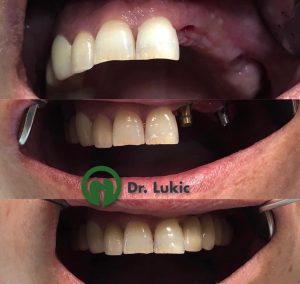
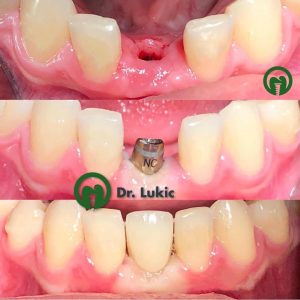
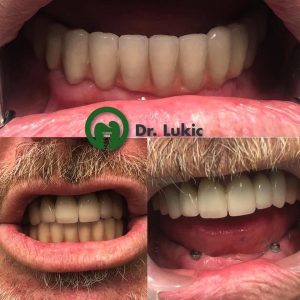
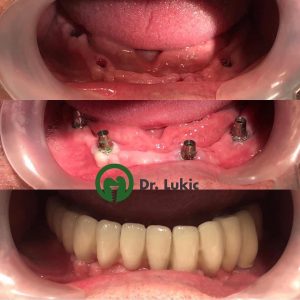
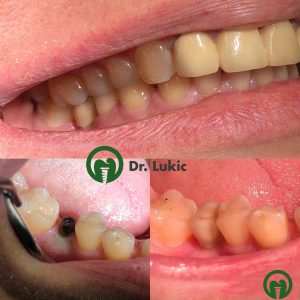
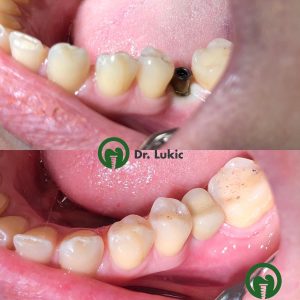
A dental implant is a titanium post (like a tooth root) that is surgically positioned into the jawbone beneath the gum line that allows the dentist to mount replacement teeth or a bridge into that area. An implant doesn’t come loose like a denture can. Dental implants also benefit general oral health because they do not have to be anchored to other teeth, like bridges.
Implants fuse to your jawbone, they provide stable support for artificial teeth. Dentures and bridges mounted to implants won’t slip or shift in your mouth — an especially important benefit when eating and speaking. This secure fit helps the dentures and bridges — as well as individual crowns placed over implants — feel more natural than conventional bridges or dentures.
For some people, ordinary bridges and dentures are simply not comfortable or even possible, due to sore spots, poor ridges or gagging. In addition, ordinary bridges must be attached to teeth on either side of the space left by the missing tooth. An advantage of implants is that no adjacent teeth need to be prepared or ground down to hold your new replacement tooth/teeth in place.
The basis for modern dental implants is a biologic process called osseointergation, in which materials such as titanium form an intimate bond to bone.
To receive implants, you need to have healthy gums and adequate bone to support the implant. You must also commit to keeping these structures healthy. Meticulous oral hygiene and regular dental visits are critical to the long-term success of dental implants. Success or failure of implants depends on the health of the person receiving the treatment, drugs which affect the chances of osseointegration. The amount of stress that will be put on the implant and fixture during normal function is also evaluated. Planning the position and number of implants is key to the long-term health of the prosthetic since bio-mechanical forces created during chewing can be significant.
Surgical Placement of the Implant Body
There are a different implant system that the dental professionals are using. Our office collaborate with Straumann implant system, which is a pioneer and global leader in implant dentistry.
There are different approaches to placement dental implants after tooth extraction. The approaches are:
Immediate post-extraction implant placement.
Delayed immediate post-extraction implant placement (two weeks to three months after extraction).
Late implantation (three months or more after tooth extraction).
Immediate placement of implant into a recent extraction site is an increasingly common strategy to preserve bone and reduce treatment times. On the one hand, it shortens treatment time and can improve aesthetics because the soft tissue envelope is preserved. On the other hand, implants may have a slightly higher rate of initial failure.
For an implant to become permanently stable, the body must grow bone to the surface of the implant (osseointegration). Based on this biologic process, it was thought that loading an implant during the osseointegration period would result in movement that would prevent osseointegration, and thus increase implant failure rates. As a result, three to six months of integrating time (depending on various factors) was allowed before placing the teeth on implants (restoring them). With Strauman Implants the time of the osseointegration is reduced from one to two monts depend of the type of the implant.
For an implant to osseointegrate , it needs to be surrounded by a healthy quantity of bone. In order for it to survive long-term, it needs to have a thick healthy soft tissue envelope around it. It is common for either the bone or soft tissue to be so deficient that the surgeon needs to reconstruct it either before or during implant placement.
Additional surgical procedures
Bone grafting is one of the additional procedures that are necessary when there is a lack of bone. While there are always new implant types, such as short implants, and techniques to allow compromise, a general treatment goal is to have a minimum of 10 mm in bone height, and 6 mm in width.
To achieve an adequate width and height of bone, various bone grafting techniques have been developed. The most frequently used is called guided bone regeneratiot where a defect is filled with either natural (harvested or autograft) bone or allograft (donor bone or synthetic bone substitute), covered with a semi-permeable membrane and allowed to heal. During the healing phase, natural bone replaces the graft forming a new bony base for the implant.
Three common procedures are:
- The sinus lift
- Lateral alveolar augmentation (increase in the width of a site)
- Vertical alveolar augmentation (increase in the height of a site)
Soft tissue management
When replacing a tooth with an implant, a band of strong, attached gingiva is needed to keep the implant healthy in the long-term. This is especially important with implants because the blood supply is more precarious in the gingiva surrounding an implant, and is theoretically more susceptible to injury because of a longer attachment to the implant than on a tooth.
When an adequate band of attached tissue is absent, it can be recreated with a soft tissue graft.
The most common soft tissue complication is called a black-triangle, where the papilla (the small triangular piece of tissue between two teeth) shrinks back and leaves a triangular void between the implant and the adjacent teeth. That is why it is very important to manage the soft tissue especially in the front areas, where the esthetics is high recommended.
Recovery
Upon the surgery, we will give you a postoperative instructions, a prescription for pain medication, antibiotics and a follow-up appointment in one week for suture removal. If you have any questions, please do not hesitate to make a call at the office.
The prosthetic phase begins once the implant is well integrated (or has a reasonable assurance that it will integrate) and an abutment is in place to bring it through the mucosa. This phase of restoring an implant requires an equal amount of technical expertise as the surgical because of the bio-mechanical considerations, especially when multiple teeth are to be restored. The dentist will work to restore the vertical dimension of occlusion, the esthetics of the smile, and the structural integrity of the teeth to evenly distribute the forces of the implants.