
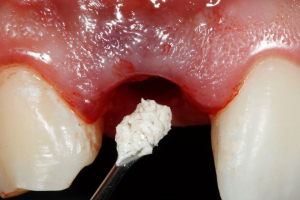
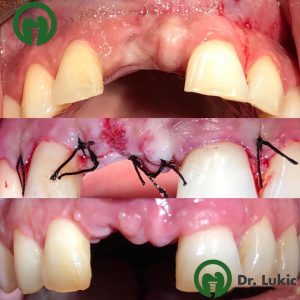
Bone augmentation is a surgical intervention to compensate for the loss of the bone in order to regenerate the vertical or horizontal dimension of the same, thus increasing the possibility of successful implantation.
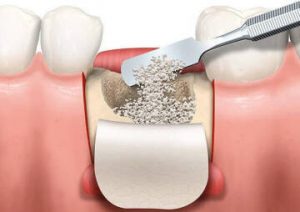
The bone generally has the ability to regenerate completely. In bone augmentation, a bone (graft) is taken from elsewhere and added to the area that should be repaired. The bone graft may be autologous (a bone taken from the patient’s own body), allograft (a cadaveric bone usually obtained from a bone bank) or synthetic (often made from hydroxyapatite or other natural and biocompatible substances) with similar mechanical properties of the bones. Most bone grafts are expected to be absorbed and integrated into new bone for several months.
After the integration period, the implant is inserted, or the augmentation can be done in one act with implantation, depending on the amount of bone to be grafted, as well as the primary stability of the implant.
Lately, synthetic bone substitutes have been used as a graft to reduce the traumatization of the patient.
Successful bone augmentation contributes the jaw bone to be strong enough to support your dental implant which at the same time should carry a prosthetic restoration on it.
Bone augmentation is also used as part of the sinus lifting procedure.
I am text block. Click edit button to change this text. Lorem ipsum dolor sit amet, consectetur adipiscing elit. Ut elit tellus, luctus nec ullamcorper mattis, pulvinar dapibus leo.